De-excitations

F. Plasser, On the Meaning of De-Excitations in Time-Dependent Density Functional Theory Computations, J. Comp. Chem. 2025, 46, e70072

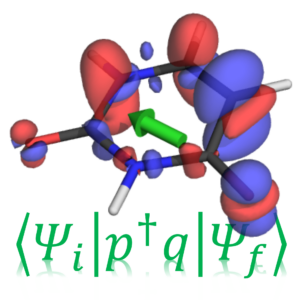
De-excitations play a central role in the mathematical formalism of time-dependent density functional theory, but their physical meaning has not been studied in detail. This work sheds new light onto this issue by showing that de-excitations arise naturally also in wave function based theories where they represent ground-state correlation.

HOMO/LUMO transitions

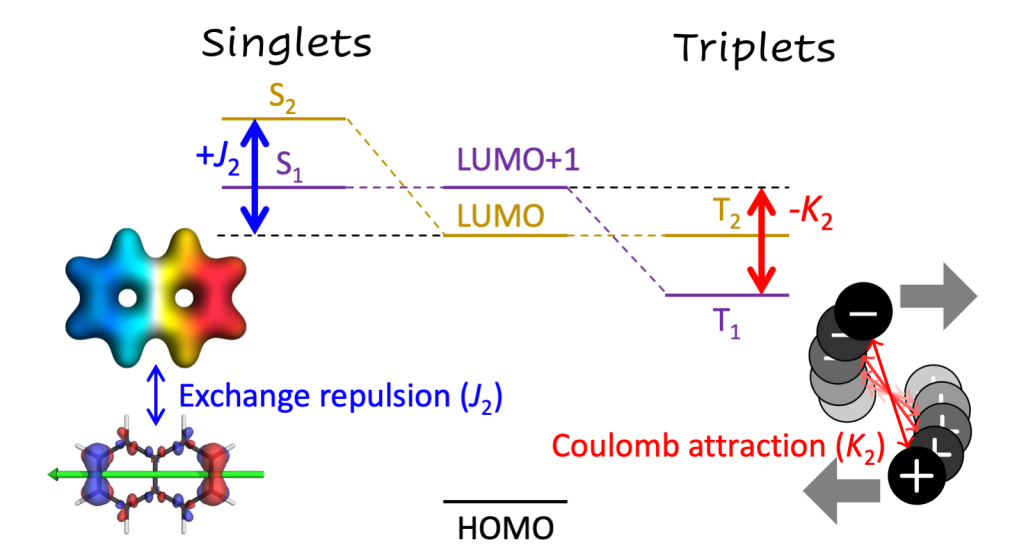
We just posted a preprint discussing a question I have been wondering about for a while: Why is the lowest excited state of a molecule not always the HOMO/LUMO transition? More generally we show how singlet and triplet state energies are affected in different ways by post-MO energy terms.

The preprint can be found here: Excited-state energy component analysis for molecules – Why the lowest excited state is not always the HOMO-LUMO transition

Update: the final published version is available here.

libwfa: Wavefunction analysis tools

Our new paper “libwfa: Wavefunction analysis tools for excited and open-shell electronic states” was just published in WiRES Comp. Mol. Sci. The libwfa library provides a variety of visual and qunantitative analysis tools to post-process excited-state computations performed within Q-Chem and OpenMolcas.

You can find the libwfa functionality in the Q-Chem documentation under General Excited-State Analysis. To activate libwfa in Q-Chem, use

state_analysis = true

In OpenMolcas use the WFA module, activated via

&WFA