XS-CASSCF

Find our new paper “Accurate energies for ππ* excited states via exchange scaling: the XS-CASSCF method” that just appeared in Chemical Science, DOI: 10.1039/D5SC09498D.

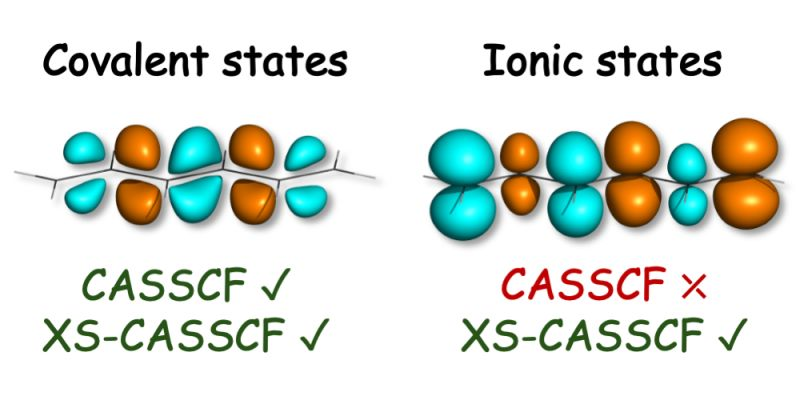
Ionic states, as understood within valence bond theory, have long been notorious for causing computational challenges, in particular for the CASSCF method. Within this work we propose a simple correction, denoted XS-CASSCF, that significantly improves the description of ionic states.

The XS-CASSCF method has been implemented within the Columbus program system.
COLUMBUS─ An Efficient and General Program Package for Ground and Excited State Computations

You can find our new paper

“COLUMBUS─ An Efficient and General Program Package for Ground and Excited State Computations Including Spin–Orbit Couplings and Dynamics” J. Phys. Chem. A 2025, 129, 28, 6482-6517.

This work describes developments on and applications of the COLUMBUS program package, which implements high-level multireference computations applicable for challenging situations and amenable for dynamics and spin-orbit coupled calculations.

Ionic states

Our new paper Quantification of the Ionic Character of Multiconfigurational Wave Functions: The Qat Diagnostic just appeared in the Journal of Physical Chemistry A.

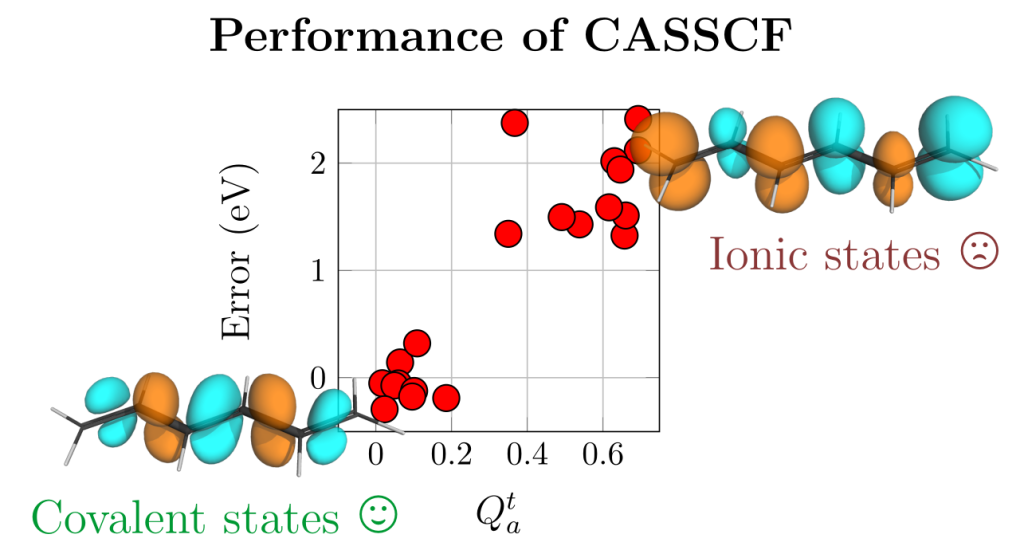
The paper deals with the fact that the widely used CASSCF method, if not used carefully, can yield large errors (1-2 eV) in vertical excitation energies. This problem arises for ionic states, as defined within valence bond theory. Within this work we developed a simple diagnostic to identify ionic states. We found a good correlation between the new diagnostic (Qta) and the error, as shown in the figure above.

We hope that the new diagnostic will be useful similar to analogous diagnostics identifying charge transfer states in TDDFT computations. This will give users the possibility to spot potential problems quickly.

On-going work is concerned with going from just diagnosing the problem to developing a numerical correction term to fix the problem.