Rationalising Exciton Interactions in Aggregates

Understanding exciton interactions via a dipole model is often not very intuitive and, more importantly, a dipole model cannot explain the short-range interactions that are often crucial in determining interchromophore interactions.

In our new article [1], exciton coupling in organic chromophores is revisited through the lens of the transition density. The presented formalism gives insight into the strength and sign of the coupling based on the relative arrangement of the lobes of the transition density explaining oscillations between H- and J-aggregate behavior observed when two molecules are displaced relative to each other.

[1] J. Krieger, F. Plasser: Rationalising Exciton Interactions in Aggregates Based on the Transition Density, Chem. Eur. J. 2025, DOI: 10.1002/chem.202501570.
Singlet-Triplet Gaps

The singlet-triplet (S1/T1) gap of an organic chromophore is a decisive property for various photophysical applications. There are well-established rules for minimizing S1/T1 gaps. Essentially all one has to do is separate the HOMO and LUMO in space and this minimises the HOMO/LUMO exchange integral and thus the S1/T1 gap.

Maximising S1/T1 gaps is a different story. Simply trying to maximise HOMO/LUMO overlaps does not help by itself help. And so far it was not clear what to do instead.

We investigated this question in a recent article:

W. Zeng, C. Zhong, H. Bronstein, F. Plasser
“Understanding and Tuning Singlet-Triplet (S1/T1) Energy Gaps in Planar Organic Chromophores”
Angew. Chem. Int. Ed., 2025, e202502485

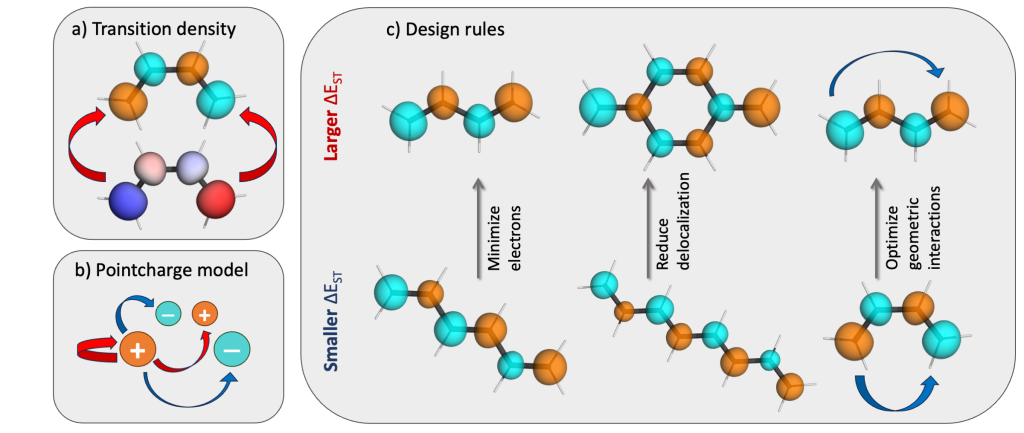
The developed strategy is summarised below. Starting from the realisation that the S1/T1 gap reflects the self-repulsion of the transition density [Phys. Chem. Chem. Phys., 2020, 22, 6058], we decompose this interaction via a formal pointcharge model. A large S1/T1 gap now corresponds to maximising repulsive interactions and minimising attractive interactions within this model. Doing so leads to three new rules for maximising S1/T1 gaps in planar organic chromophores:

  • Minimising the number of π-electrons: smaller molecules generally have larger S1/T1 gaps.
  • Reducing delocalisation: the S1/T1 gap goes up if they excitation can be localised on a subset of the carbon atoms.
  • Optimising through-space geometric interactions: to maximise S1/T1 gaps one most avoid s-cis type 1,4-interactions.

Luminescent diradicals

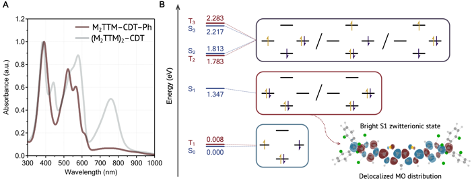
π-conjugated diradicals can possess unique luminescence properties if their zwitterionic states are harnessed. Crucially, if S0 and T1 form a quasidegenerate ground state, then the first excited state of such a system is a singlet. This, in turn, can be used to reduce triplet loss channels. The full story here:

Near-infrared luminescent open-shell π-conjugated systems with a bright lowest-energy zwitterionic singlet excited state, which just appeared in Science Advances.

Planar chromophore design

It is by now fairly well understood how chromophore properties are affected by push/pull substituents and their degree of planarity. But how can we rationalise variations in the properties of planar chromophores that do not possess charge transfer character?

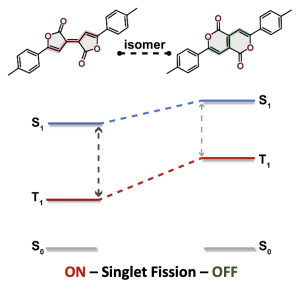
We were interested in understanding the apparent differences between these two isomeric molecules (called the Pechmann dyes).

Why is the T1 of PM5 (shown to the left) so much lower than the one of PM6 (shown to the right) making PM5 a powerful candidate for a singlet fission material whereas the S1/T1 gap of PM6 is too small for this purpose?

The answer is discussed in the new paper “Singlet Fission in Pechmann Dyes: Planar Chromophore Design and Understanding” that just appeared in JACS.

The overall lower excitation energies of PM5 vs PM6 can be understood by the fact that the S1 and T1 of the former are stabilised via excited-state aromaticity whereas the S0 of the latter profits from ground-state aromaticity.

The reason for the lower S1/T1 gap in PM5 is more subtle but also more fascinating pointing to a whole new way of viewing excitation energies. We were able to highlight the effect of the double bond conformation in influencing the exchange integral between the excited electron and hole, which ultimately leads to the variations in S1/T1 gap.

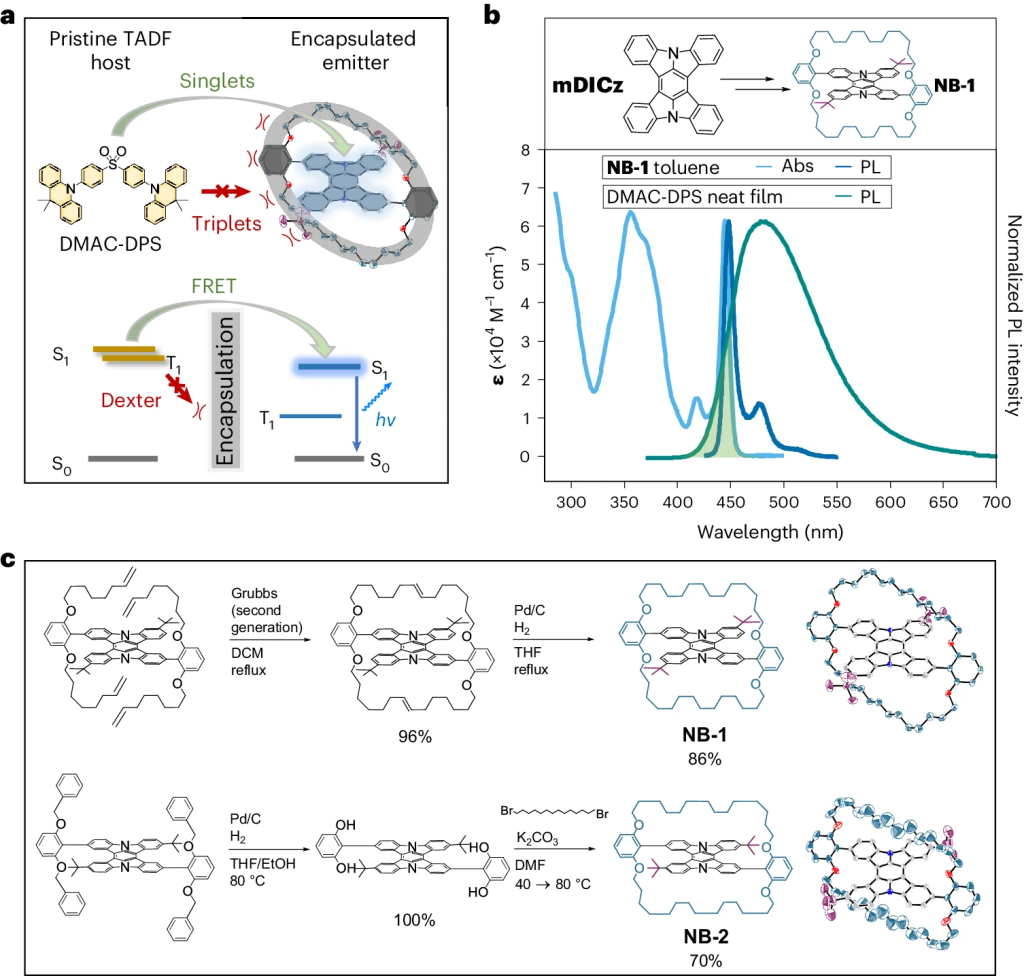
Matrix-free hyperfluorescence

Hyperfluorescence is an emerging technique for generating highly efficient OLEDs by combining a triplet harvester with a bright emitter molecule. Current devices are overly complex due to the number of components involved hampering practical application. A new paper, led by Hugo Bronstein from the University of Cambridge presents an important step toward solving this problem. The idea is to encapsulate the emitter, thus, avoiding the need for a high-gap matrix. The approach is presented in the paper Suppression of Dexter transfer by covalent encapsulation for efficient matrix-free narrowband deep blue hyperfluorescent OLEDs, which just appeared in Nature Materials.