Find our new paper “Accurate energies for ππ* excited states via exchange scaling: the XS-CASSCF method” that just appeared in Chemical Science, DOI: 10.1039/D5SC09498D.
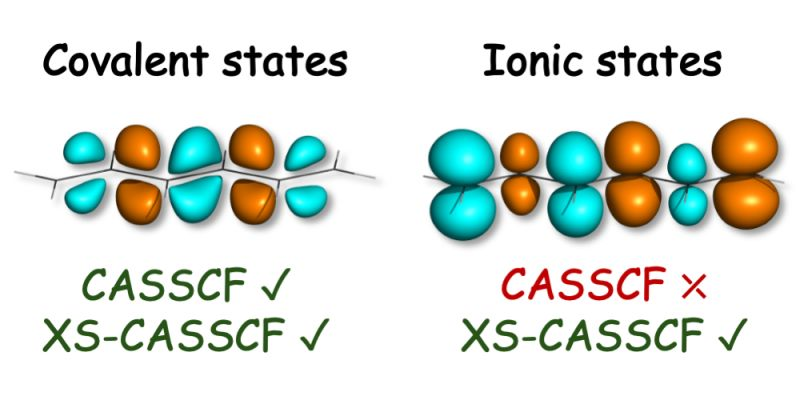
Ionic states, as understood within valence bond theory, have long been notorious for causing computational challenges, in particular for the CASSCF method. Within this work we propose a simple correction, denoted XS-CASSCF, that significantly improves the description of ionic states.
This work describes developments on and applications of the COLUMBUS program package, which implements high-level multireference computations applicable for challenging situations and amenable for dynamics and spin-orbit coupled calculations.
The COLUMBUS programme package – a collection of programs for high-level ab initio molecular electronic structure calculations – has been released open-source. Please find
Dylan has finished his MChem project entitled “Visualisation of Aromaticity and Antiaromaticity via the Computation of the Chemical Shielding on Multi-Dimensional Grids.” You can find his report here. The purpose of his project was to develop a convenient method for computing shielding tensors on a grid around a molecule. The developed code is available via github.
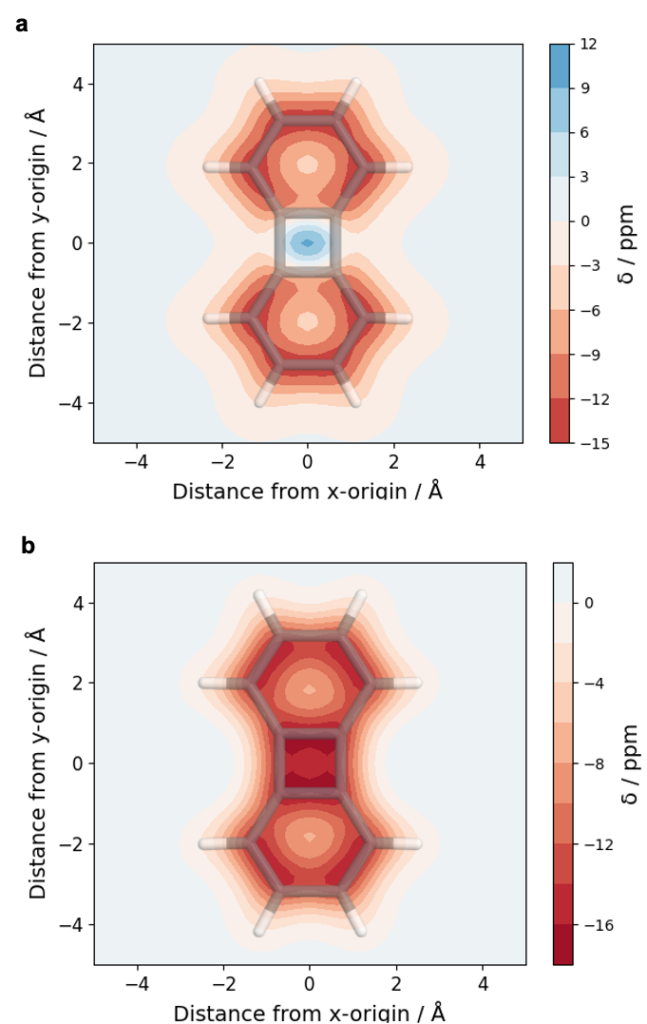
Below, an analysis of biphenylene is shown in the singlet (a) and triplet (b) state. For the singlet this representation highlights the aromaticity (red) of the benzene rings whereas the central 4-membered ring is found to be antiaromatic (blue). In the triplet (b), the whole molecule is found to be aromatic (red) according to Baird’s rule.
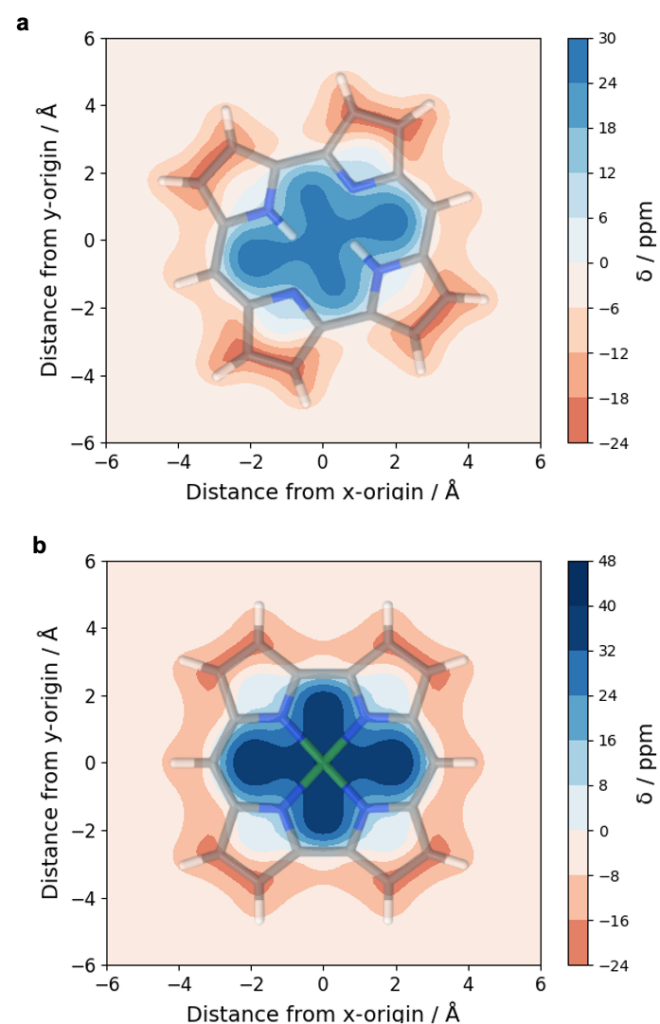
An analysis of norcorrole using either its doubly protonated form (a) or a nickel complex (b) highlights the antiaromaticity at the centre of this molecule whereas an aromatic pathway is found at the perimeter (see also [P. B. Karadakov, Org. Lett.2020, 22, 8676]).