XS-CASSCF

Find our new paper “Accurate energies for ππ* excited states via exchange scaling: the XS-CASSCF method” that just appeared in Chemical Science, DOI: 10.1039/D5SC09498D.

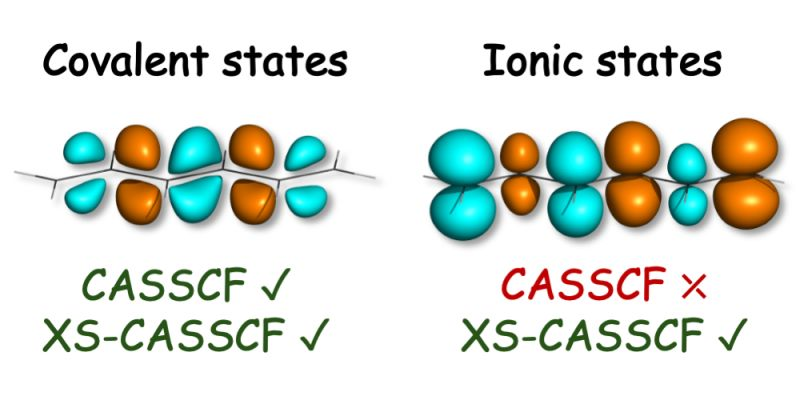
Ionic states, as understood within valence bond theory, have long been notorious for causing computational challenges, in particular for the CASSCF method. Within this work we propose a simple correction, denoted XS-CASSCF, that significantly improves the description of ionic states.

The XS-CASSCF method has been implemented within the Columbus program system.
Low-lying excited states of linear all-trans polyenes

The excited states of polyenes provide a crucial test case for electronic structure methods. Here, the challenge is to describe excited states of varying character (doubly excited and ionic) in a balanced manner.

We present a refined strategy toward this task in the article:

Julio C. V. Chagas et al. “Low-lying excited states of linear all-trans polyenes: the σ–π electron correlation and the description of ionic states” Phys. Chem. Chem. Phys., 2025, 27, 7916-7928.

COLUMBUS─ An Efficient and General Program Package for Ground and Excited State Computations

You can find our new paper

“COLUMBUS─ An Efficient and General Program Package for Ground and Excited State Computations Including Spin–Orbit Couplings and Dynamics” J. Phys. Chem. A 2025, 129, 28, 6482-6517.

This work describes developments on and applications of the COLUMBUS program package, which implements high-level multireference computations applicable for challenging situations and amenable for dynamics and spin-orbit coupled calculations.

De-excitations

F. Plasser, On the Meaning of De-Excitations in Time-Dependent Density Functional Theory Computations, J. Comp. Chem. 2025, 46, e70072

De-excitations play a central role in the mathematical formalism of time-dependent density functional theory, but their physical meaning has not been studied in detail. This work sheds new light onto this issue by showing that de-excitations arise naturally also in wave function based theories where they represent ground-state correlation.

Ionic states

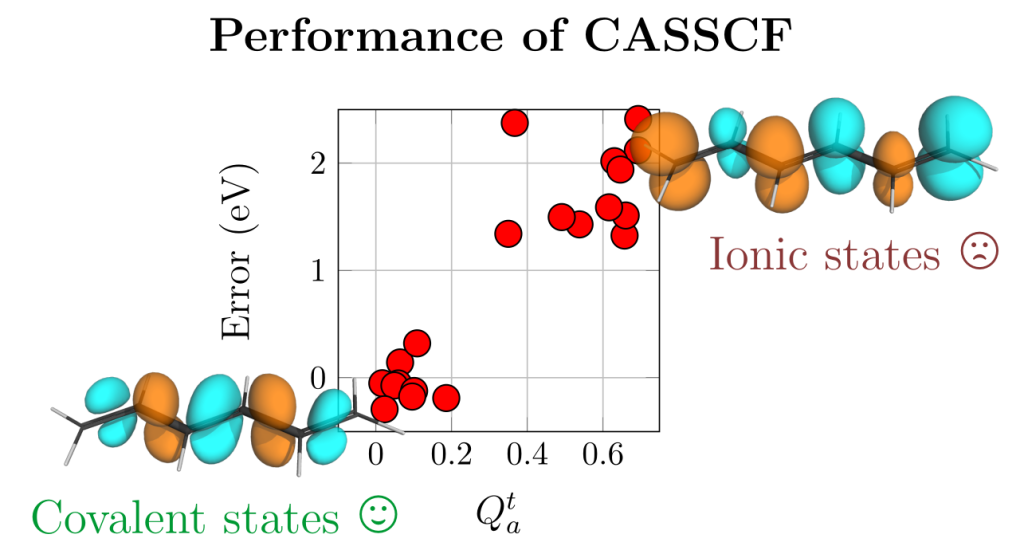
Our new paper Quantification of the Ionic Character of Multiconfigurational Wave Functions: The Qat Diagnostic just appeared in the Journal of Physical Chemistry A.

The paper deals with the fact that the widely used CASSCF method, if not used carefully, can yield large errors (1-2 eV) in vertical excitation energies. This problem arises for ionic states, as defined within valence bond theory. Within this work we developed a simple diagnostic to identify ionic states. We found a good correlation between the new diagnostic (Qta) and the error, as shown in the figure above.

We hope that the new diagnostic will be useful similar to analogous diagnostics identifying charge transfer states in TDDFT computations. This will give users the possibility to spot potential problems quickly.

On-going work is concerned with going from just diagnosing the problem to developing a numerical correction term to fix the problem.

Classification and Analysis of Excited States

A new book chapter by Patrick and Felix just appeared online: “Classification and Analysis of Molecular Excited States“. Ultimately, this chapter will be part of the Comprehensive Computational Chemistry series published by Elsevier.

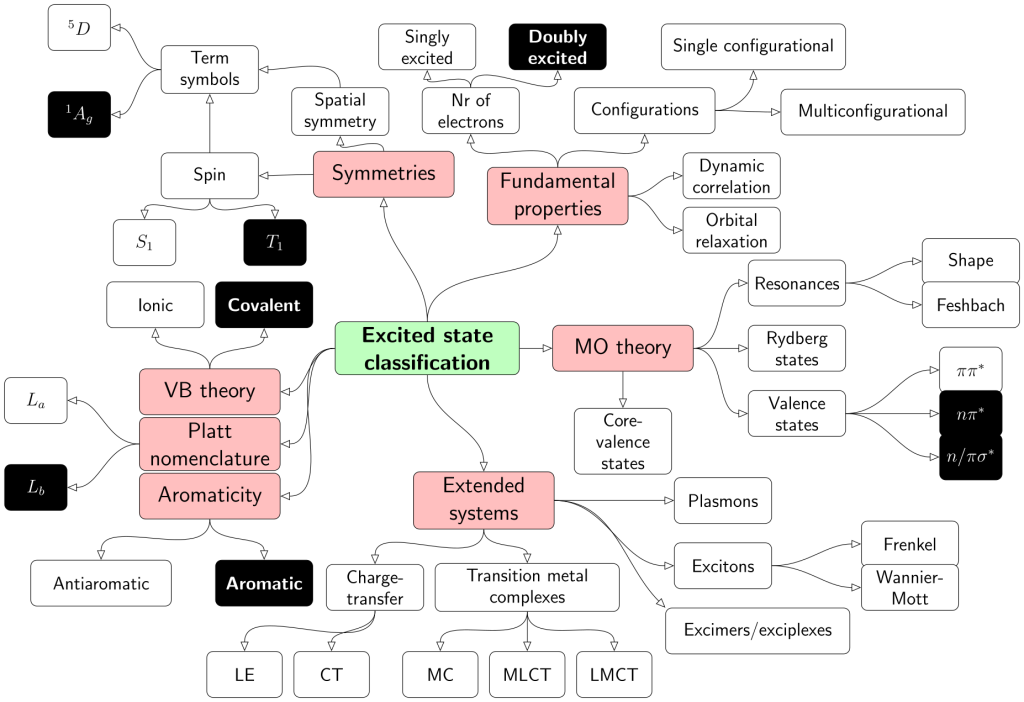
In this chapter we explore the various ways in which excited states are classified, that is, according to

  • the molecular orbitals involved,
  • valence bond resonance structures,
  • spatial and spin symmetry,
  • more fundamental wavefunction properties (double excitations, correlation, etc),
  • excited-state aromaticity, and
  • delocalisation and charge transfer.

The map below shows the different classes and highlights the multitude of ways that are used to discuss excited states in the literature.

It is the purpose of this chapter to discuss all these types of states, covering the mathematical and physical background as well as the consequences to spectroscopy and photochemistry.

Paper: Multireference Approaches for Excited States

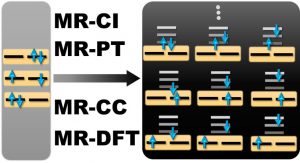
We just published a comprehensive and quite voluminous review paper about “Multireference Approaches for Excited States of Molecules”  in Chemical Reviews. The paper covers the major methods used nowadays, such as CASSCF, multireference (MR) configuration interaction, MR perturbation theory, and MR coupled cluster. It discusses the application of semiempirical Hamiltonians as well as connections to DFT. The emerging algorithms DMRG and full-CI Quantum Monte Carlo are included as well. The theory of gradients as well as MR diagnostics and wavefunction analysis are discussed. The presented applications include a variety of cases starting from diatomics and going to complexes and dimers.

For a more detailed discussion of the paper, visit barbatti.org. For download options, see below.

Download Options