Take a look at a new preprint from the Kimber group at Loughborough: Photoredox-Catalyzed Intermolecular Radical Addition to Allenamides: A Complementary Approach to Conjugated N-Acyliminium Formation. It’s a great piece of synthetic chemistry with a bit of help from computation in terms of characterising the iminium intermediate.
New functionality for OpenMolcas
An update of the WFA module has been posted to OpenMolcas. This update integrates the fragment-based analysis that was previously only available via the TheoDORE code. In particular, it allows the automatic analysis of excited-state character in transition metal complexes [1, 2] with just a few added lines in the input file to OpenMolcas. This functionality is described here.
Thank you to Feng Chen from Loughborough University’s Research Software Engineering program for implementing the new code.
Paper: Details in the surface hopping method
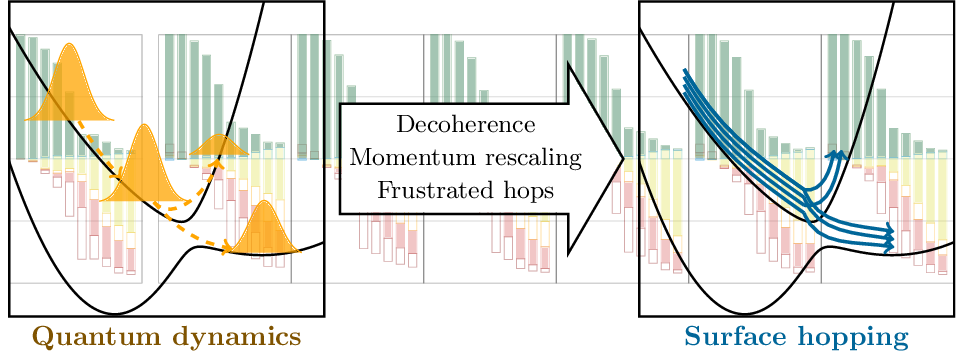
Our paper “Strong Influence of Decoherence Corrections and Momentum Rescaling in Surface Hopping Dynamics of Transition Metal Complexes” was just accepted in JCTC. In this work we investigated the reliability of the surface hopping method in the case of a transition metal complex described using a linear vibronic coupling model. We found that various seemingly unimportant parameters can have a strong influence on the results.
Paper: Two-photon absorption
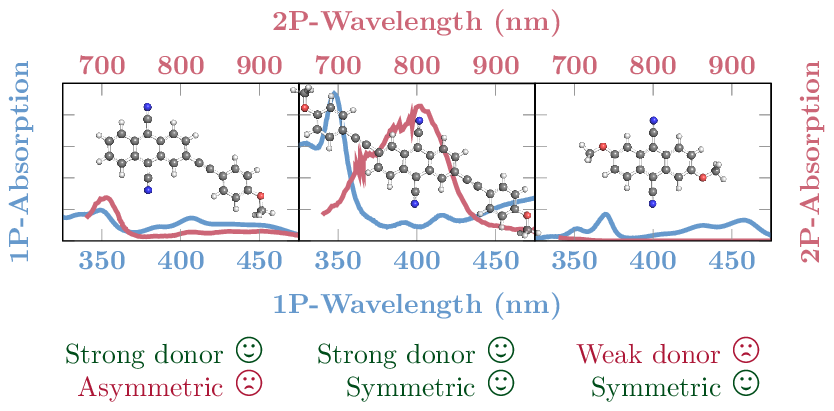
Our new paper Effect of Symmetric and Asymmetric Substitution on the Optoelectronic Properties of 9,10-Dicyanoanthracene, written in collaboration with colleagues from Imperial College London, TU Vienna, University of Geneva, and the Polish Academy of Sciences just appeared in the new RSC journal Molecular Systems Design & Engineering. The paper illustrates design principles relevant for strong two-photon absorbers. The best two-photon absorption is obtained by using a symmetric D-A-D arrangement with sufficiently strong donors.
Talk: Excited states of transition metal complexes
On Thursday, 20/06, Felix will give a talk at the CECAM workshop on Theoretical and Computational Inorganic Photochemistry in Toulouse. This talk will discuss how excited states in transition metal complexes can be assigned completely automatically without ever looking at an orbital. It is shown how this method can be used for a high-throughput analysis of excited states as well as for benchmarking excited-state computations. Finally, a quick outlook will be given on how correlation effects can be visualised using a newly developed tool for computing conditional electron/hole densities.
You can download the slides here:
Preprint: Details in the surface hopping algorithm
Having discussed the influence of electronic structure methods in surface hopping dynamics in the last post and paper, we can now proceed to the surface hopping algorithm itself. To our surprise, algorithmic details such as the decoherence correction (energy-based decoherence or augmented FSSH), momentum rescaling and the treatment of frustrated hops can make a big difference. This is what we investigated in our new preprint “Strong Influence of Decoherence Corrections and Momentum Rescaling in Surface Hopping Dynamics of Transition Metal Complexes” available on ChemArxiv.
To have a well-defined reference, we used our new implementation of vibronic coupling models for surface hopping, which allows us to have a one-to-one comparison with accurate quantum dynamics computed at the MCTDH level of theory. As model system, we used a rhenium complex and studied its ultrafast intersystem crossing dynamics from the singlet to the triplet manifold following previous studies by our collaborators in Strasbourg [JCTC (2017), PCCP (2018)].
Paper: Electronic structure methods for dynamics simulations
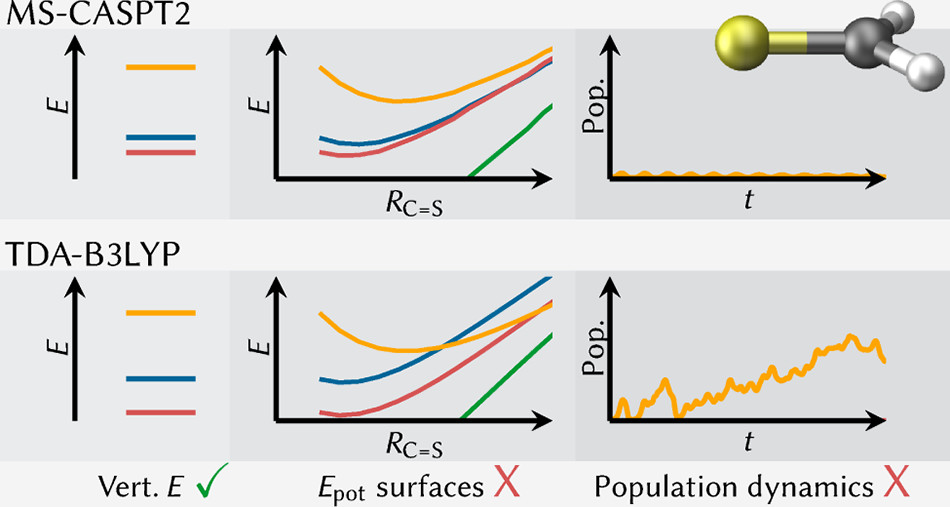
The challenge about running photodynamics simulations is that the computational cost is often so high that one might have to compromise in terms of the electronic structure method used. One is tempted to just check the vertical excitations at one geometry and run the dynamics if those look alright. How this can go wrong is investigated in the paper “The Influence of the Electronic Structure Method on Intersystem Crossing Dynamics. The Case of Thioformaldehyde” that just appeared in JCTC. Take a look if you are interested.
Copyright 2019 American Chemical Society.
Paper: Delayed fluorescence
Small modifications can make a big difference. Swapping anthraquinone for a thiophene based acceptor in a donor-acceptor-donor system produces the desired red shift in the emission but limits its quantum efficiency. This conclusion was drawn from a recent paper lead by Stephanie Montanaro and Iain Wright at Loughborough: Red-shifted delayed fluorescence at the expense of photoluminescence quantum efficiency – an intramolecular charge-transfer molecule based on a benzodithiophene-4,8-dione acceptor which just a appeared in PCCP.
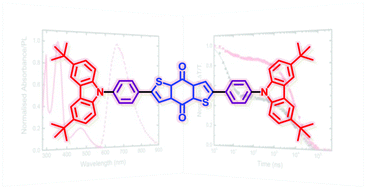
Computations reveal that the reason for the reduced emission quantum efficiency lies in the presence of low-lying locally excited states (4 triplets and one singlet) on the central unit.
Release of TheoDORE 2.0 (beta)
Version 2.0 of the TheoDORE wavefunction analysis package has been released, download below. The two main features of TheoDORE 2.0 are the computation of conditional electron densities and compatibility with python3.
Conditional electron densities can be used for the visualisation of excited-state electron correlation, see ChemPhotoChem (2019). Below, the application of this method to a PPV oligomer is shown. Here, the probe hole (red) is always fixed on the terminal phenyl ring and the different shapes for the conditional electron density (blue) for the first six excited states is observed. One can see that for the different states the electron is either repelled, attracted or unaffected by the hole.
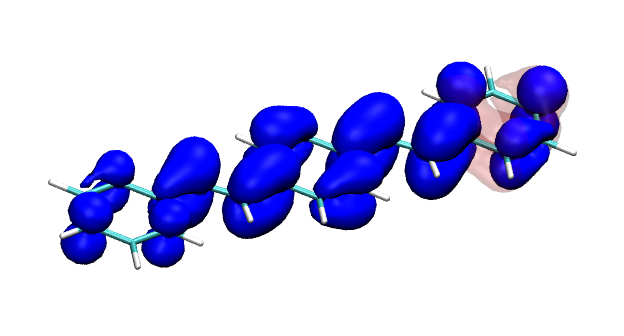 S1
S1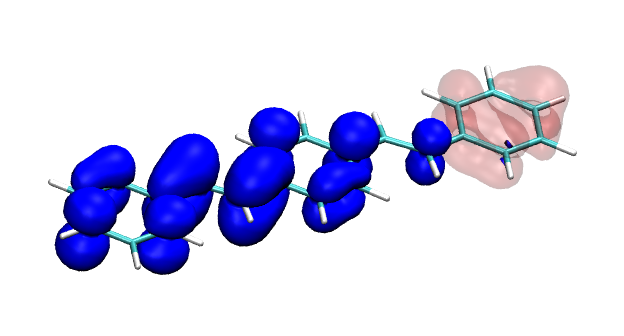 S2
S2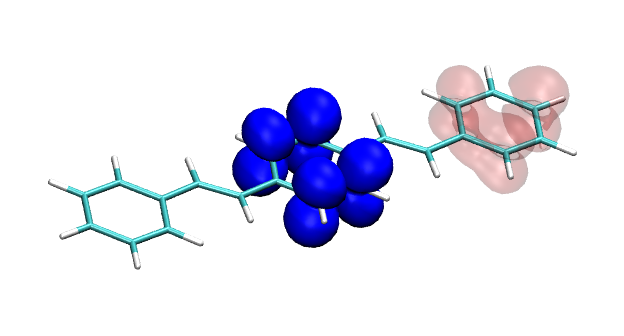 S3
S3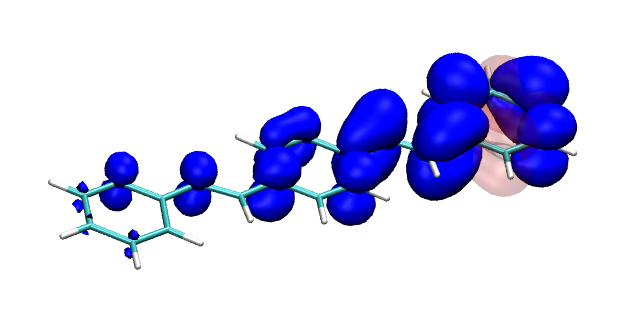 S4
S4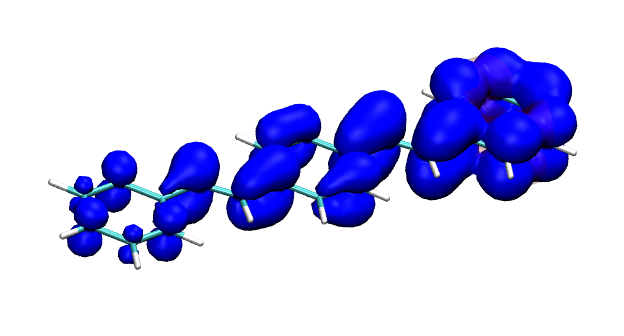 S5
S5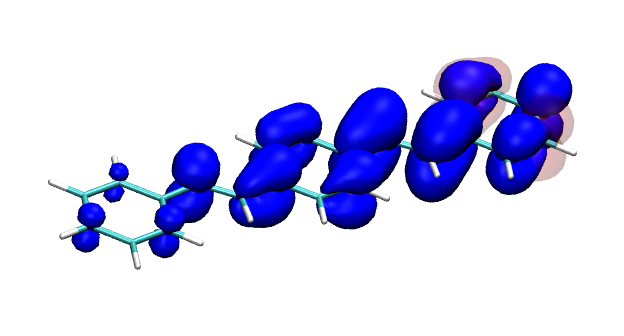 S6
S6
Highly cited paper in JCTC
A paper co-authored by Felix has been featured as the top highly cited paper in J. Chem. Theory Comput. for 2018. Our paper “Benchmarking Excited-State Calculations Using Exciton Properties” has received 22 citations since its publication in early 2018. The paper deals with the question of how we can assess the reliability of excited-state computations in a rigorous and reproducible fashion.