Release of Columbus 7.0.1

A new release of Columbus (version 7.0.1) is available. The main improvement compared to previous releases is that the binary distribution now contains a pre-compiled parallel CI executable as well as an interface to Molcas.

  • The parallel CI executable is linked against the Intel MPI libraries, which should be available on most computing centres and can otherwise be downloaded freely from Intel.
  • The Molcas interface proceeds via the free Molcas@UU distribution.
    Note: At the moment, there is no interface to OpenMolcas available in the distribution.

Source and binaries as well as more detailed instructions are available via the usual download page (register here). Let me know about any successes or problems regarding these features.
Exciton-exciton annihilation

A new study led by C. Heshmatpour and J. Hauer from TU München studies exciton-exciton annihilation in a squaraine trimer. The experiment exploits 5th-order optical spectroscopy to study the evolution of the trimer after two-photon excitation into its bi-exciton state. Quantum chemistry computations performed by M. Menger, now located at Groningen, provide the required parameters to model the experimental signals within a Frenkel exciton model. The associated article Annihilation Dynamics of Molecular Excitons Measured at a Single Perturbative Excitation Energy just appeared in J. Phys. Chem. Lett.

Photoredox catalysis

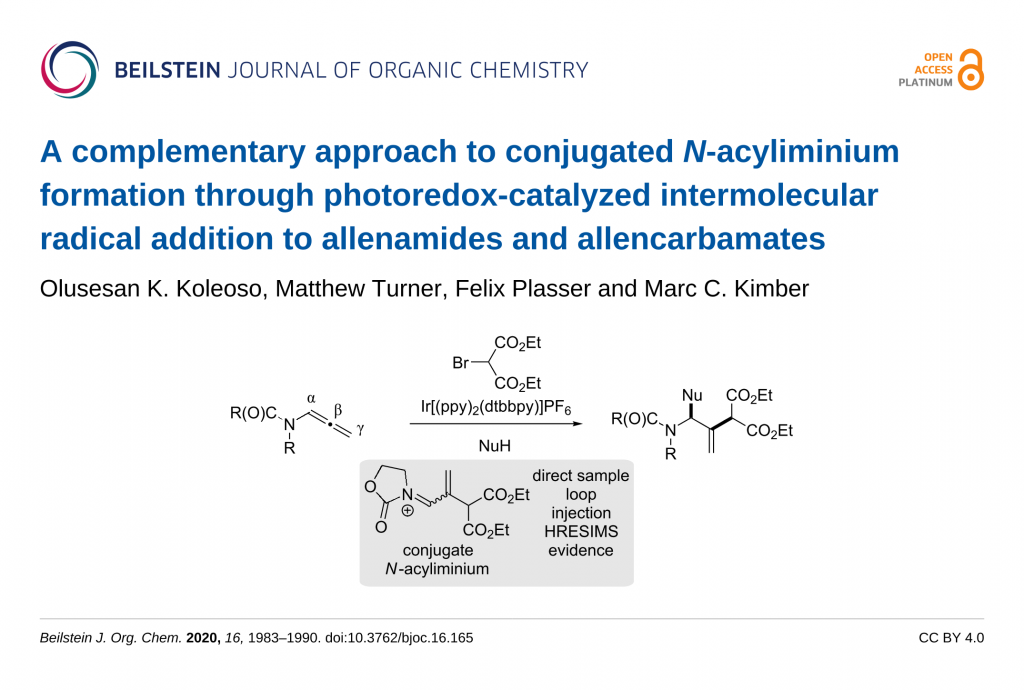
A study led by O. Koleoso and M. C. Kimber at Loughborough University explored a new route of synthesising conjugated N-acyliminium compounds. The article entitled “A complementary approach to conjugated N-acyliminium formation through photoredox-catalyzed intermolecular radical addition to allenamides and allencarbamates” just appeared in a thematic issue on Advances on photoredox catalysis in the Beilstein Journal of Organic Chemistry.

Solution processed solar cells

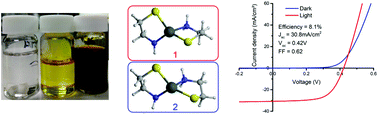
A study lead by J. Lowe and A. Malkov from Loughborough University investigates how kesterite solar cells can be formed via a new cheap and non-toxic solvent system. The associated paper just appeared in J. Mat. Chem. C: Solution processed CZTS solar cells using amine–thiol systems: understanding the dissolution process and device fabrication.

Quantum chemical computations were used to aid in the assignment of the structures produced and characterised via infrared multiple photon dissociation spectroscopy. An interactive model showing the relevant molecular vibrations can be found here.

Release of TheoDORE 2.2

Version 2.2 of the TheoDORE wavefunction analysis package is available. Download the current version below.

New features of TheoDORE 2.2:

  • Support for spin-unrestricted calculations (by Sebastian Mai) – currently only tested for ORCA
  • Substituent-induced electron localization (SIEL) as described in Chem. Sci. 2020, 10.1039/D0SC01684E

TheoDORE – Download

Download the newest release of the TheoDORE wavefunction analysis program – TheoDORE 3.2 (22 July 2024)

Size: 12 MB
Version: 3.2

Full release notes:

Continue reading

Directional excitations in photosensitisers

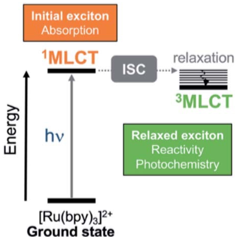
Characterising excited states in transition metal complexes by looking at pictures of orbitals can be a tedious task. Even more, it is hard to eliminate personal in the process and produce quantitative results. In a study led by Pedro Sánchez-Murcia from the University of Vienna, we have taken a closer look at this problem in the case of various substituted complexes deriving from the archetype Ru(bpy)3 with the aim of quantifying how different substituents influence the localisation of the excited electron. The result is presented in the article “Orbital-free photophysical descriptors to predict directional excitations in metal-based photosensitizers,” which just appeared in Chemical Science.

The Columbus program system

Columbus is a collection of programs for high-level ab initio electronic structure computations. Through the use of multireference methods even highly challenging systems such as excited states and open-shell molecules are accessible. The availability of gradients and nonadiabatic coupling vectors allows for photodynamics simulations describing ultrafast internal conversion processes. The capabilities of Columbus have been showcased in a recent paper: The generality of the GUGA MRCI approach in COLUMBUS for treating complex quantum chemistry that just appeared in J. Chem. Phys. as part of a themed collection Electronic Structure Software.

A new release of the programm package, available to registered users, has been made available on the distribution page.

Paper: Rational design of chromophores for singlet fission

Singlet fission is a promising approach to photovoltaics where one pair of singlet charge carriers is converted intto two pairs of triplet charge carriers. Molecules undergoing singlet fission require a specific energetic condition: the first triplet state has to be half the energy of the first singlet state. In a study, lead by Max Pinheiro from Sao Paulo, Brazil, we investigated how this energetic condition can be achieved by substituting a tetracene molecule with B and N atoms in different positions. The resulting paper A systematic analysis of excitonic properties to seek optimal singlet fission: the BN-substitution patterns intetracene, which just appearred in J. Mat. Chem. C, shows the versatility of this approach in tuning the energies across a wide range. The results are rationalised by measuring unpaired electrons and compared to a more qualitative discussion in terms of bonding patterns and Clar sextets. We hope that the study will help by setting new accents in terms of design ideas for new chromophores.

For recent study presenting an alternative strategy of tuning energies for singlet fission, exploiting anti-aromaticity, see JACS 2019, 141, 13867.