Talk at QBIC IV in Bath

On 5 September, Felix Plasser will give a talk entitled “Transition Metal Complex Excited States: Turning Numbers into Chemical Insight” at the Quantum-Bio-Inorganic Chemistry Conference IV in Bath. The talk will discuss the automatic assignment of excited-state character for transition metal complexes and present some recent results about using conditional electron densities for visualising excited-state correlation effects.

You can download the slides here:

Talk at EuCheMS in Liverpool

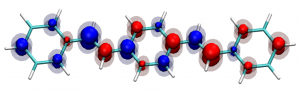
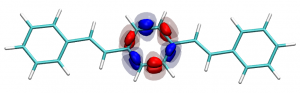
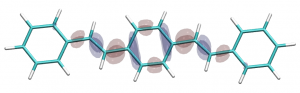
On 29 August, Felix Plasser will give a talk entitled “Analysis of Excited-State Computations: Turning Numbers into Chemical Insight” at the 7th EuCheMS Chemistry Congress in Liverpool. The talk will present an automatic analysis of thousands of excited states in the case of interacting DNA nucleobases and introduce a method for analysing electron correlation effects in real space, exemplified in the case of a conjugated polymer.

You can download the slides here:

Paper: Multireference Approaches for Excited States

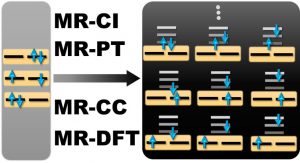
We just published a comprehensive and quite voluminous review paper about “Multireference Approaches for Excited States of Molecules”  in Chemical Reviews. The paper covers the major methods used nowadays, such as CASSCF, multireference (MR) configuration interaction, MR perturbation theory, and MR coupled cluster. It discusses the application of semiempirical Hamiltonians as well as connections to DFT. The emerging algorithms DMRG and full-CI Quantum Monte Carlo are included as well. The theory of gradients as well as MR diagnostics and wavefunction analysis are discussed. The presented applications include a variety of cases starting from diatomics and going to complexes and dimers.

For a more detailed discussion of the paper, visit barbatti.org. For download options, see below.

Download Options

Paper: Vibronic coupling constants

You can find our new paper “Interstate vibronic coupling constants between electronic excited states for complex molecules” that recently appeared in JCP. The purpose of this paper was the development of a method that allows to determine interstate vibronic coupling constants, which are a decisive ingredient for model Hamiltonians used in quantum dynamics. Our idea was to start with a method based on wavefunction overlaps that is commonly used for trajectory dynamics simulations and adapt it for the case of quantum dynamics.

Paper: Analysis of Transition Metal Complex Excited States

Doing computations on transition metal complexes can be very challenging. The problem is not only to find the correct computational method. But once the computation is finished, it is often difficult to even describe the results. The reason is that in the case of transition metal complexes there are many different possible types of state characters, a high density of states, and the orbitals are often not well resolved. Additional complications come into play due to spin-orbit coupling. For these reasons, we decided to  take a close look at how one could make the analysis of excited states in transition metal complexes easier.

Continue reading